
North Attleborough Past Residents Sources
A North Attleborough address trail changes sources as it crosses eras. The current parcel supplies a parcel identifier and situs. The Registry ties names to recorded transfers. Library directories and the annual Residents' Listed Books give dated household snapshots. Maps and newspapers add context. None of these offers a universal list of past residents, so log each find with its date, its custodian, and its limits before treating the North Attleborough trail as complete.
| Source | Years It Covers | Where Held | What It Shows |
|---|---|---|---|
| Vision assessor parcel card | Current assessment and sales research | North Attleborough Assessors / Vision Government Solutions | Situs, owner or co-owner, mailing address, values, sales, map and parcel clues |
| Recorded Land Inquiry | Portal display from 4/4/1735, Book 24, through current date | Northern Bristol County Registry of Deeds | Grantor/grantee, document type, date, document number, book/page, town, and image link |
| Historical Tor/Tee books | 1686-1910 | Northern Bristol County Registry of Deeds | Scanned alphabetical grantor/grantee index books |
| Local directories and Persons Listed books | Local directory microfilm partial from 1883; Persons Listed annually back to 1941 | Richards Memorial Library | Dated name and address snapshots, with historical occupation usually present in directories |
| State Library directory holdings | Listed runs from 1877-78 through 1990 | Massachusetts State Library | Catalog route for North Attleboro volumes |
| O.H. Bailey and Sanborn maps | Bailey 1878 and 1891; related Sanborn dates include 1885, 1889, 1894, 1899 | Library-linked resources and Library of Congress | Street, structure, and numbering context, not legal title |
A recent transfer starts with the parcel. Then use the Registry index. An older address calls for more layers: the historical books, the directory catalog, library microfilm, maps, and newspapers. The Registry's own pages describe different historical reaches, so keep them separate: its current inquiry displays data from 4/4/1735, the Tor/Tee books extend to 1686, and its public-records page describes images back to 1751 with post-1951 indices online. Each claim belongs to its own source.
North Attleborough Past Residents Parcel Base
A North Attleborough previous residents search starts with the present address. Normalize it first. Save the parcel identifier that comes back. The North Attleborough Assessors / Vision Government Solutions portal supports property and sales research. A typical parcel card shows situs, owner or co-owner, an owner mailing address, assessment values, sales history, land and building features, and a map link. Formats vary by town. Copy the identifier exactly as the live record displays it rather than guessing a pattern.
A situs is the parcel's physical location. An owner mailing address is where assessment mail goes. Neither proves anyone lived there on a given date. The record can hide complications too. The street may have carried a historical name, or the owner may be a trust, a corporation, or someone who simply receives mail elsewhere. Treat the town record as a starting point. Save its source date, the current owner spelling, the parcel key, and any book or page lead before moving on to the Registry.
The North Attleborough Assessors Office page supplies the town route for property research. It can answer assessment or abutter-list questions when the online card falls short. A live office page beats a saved map image.
North Attleborough Past Residents Deed Chain
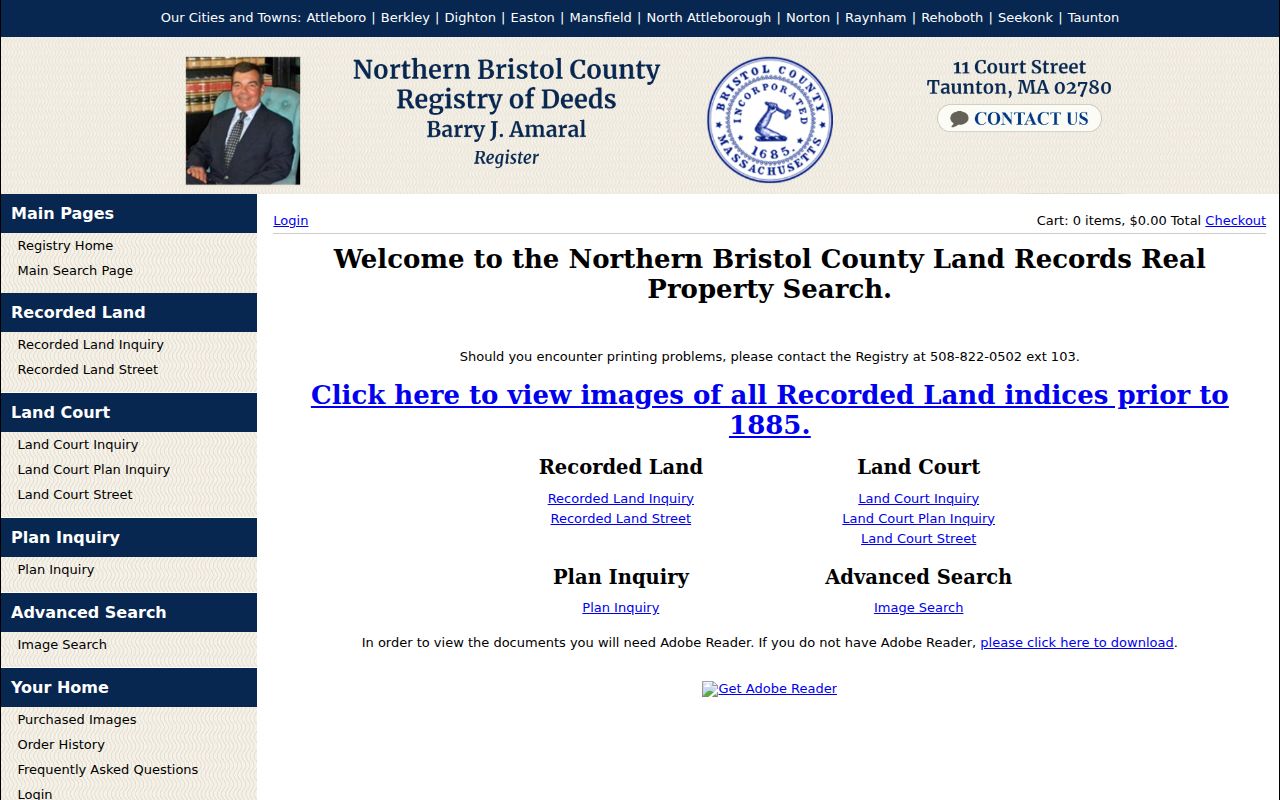
The Northern Bristol County Registry of Deeds search portal anchors the record trail for legal transfers of North Attleborough land. Its Recorded Land Inquiry is flexible. Search by Start Date, End Date, document type, last name, first name, town, or grantor, grantee, and both. The index schema is rich. It lists party, role, document type, recording date, document number, book and page, town, and an image link. Viewing online is free. Paper copies cost $1 per page. The Registry portal links the North Attleborough address trail to recorded-land searches and images.
Read the deed image or the cited book and page before accepting any match. A shared surname can point to different land. Older documents may omit the address entirely. The legal description, plan reference, book and page, and nearby parcel references are what keep the chain tied to the same North Attleborough ground.
- Open the current North Attleborough parcel record and record the owner spelling, parcel key, situs, and any sale or book/page lead.
- In Recorded Land Inquiry, search that buyer as a grantee with North Attleborough selected and a broad enough date range.
- Open the matching document image or citation. Record the seller, legal description, document number, and book/page.
- Search that seller as a grantee to locate the seller's earlier acquisition, then repeat the comparison of land descriptions.
- When the modern address query fails, search the people named in the chain and test historical street names. Move to Tor/Tee books when the relevant era calls for them.
- Grantor
- The party transferring an interest in a recorded land document.
- Grantee
- The party receiving that interest. A prior owner is commonly found by searching the later seller as an earlier grantee.
- Chain of title
- The ordered sequence of transfers for the same land, tested through names, descriptions, and record citations.
- Legal description
- The deed's land description, plan, or certificate reference. It is more stable than a street label when names or numbers changed.
North Attleborough Past Residents Before 1910
An address reaching into the earlier deed era needs the Registry's historical Tor/Tee index books alongside the modern inquiry. These are scanned alphabetical volumes covering 1686-1795, 1795-1840, 1840-1866, 1867-1880, and 1881-1910. They are not a fielded search form. Try surname variants. Work from the latest confirmed party backward. Note the index volume and page each time, and use The Registry's historical Tor/Tee index-book page for the official links to the scanned North Attleborough series.
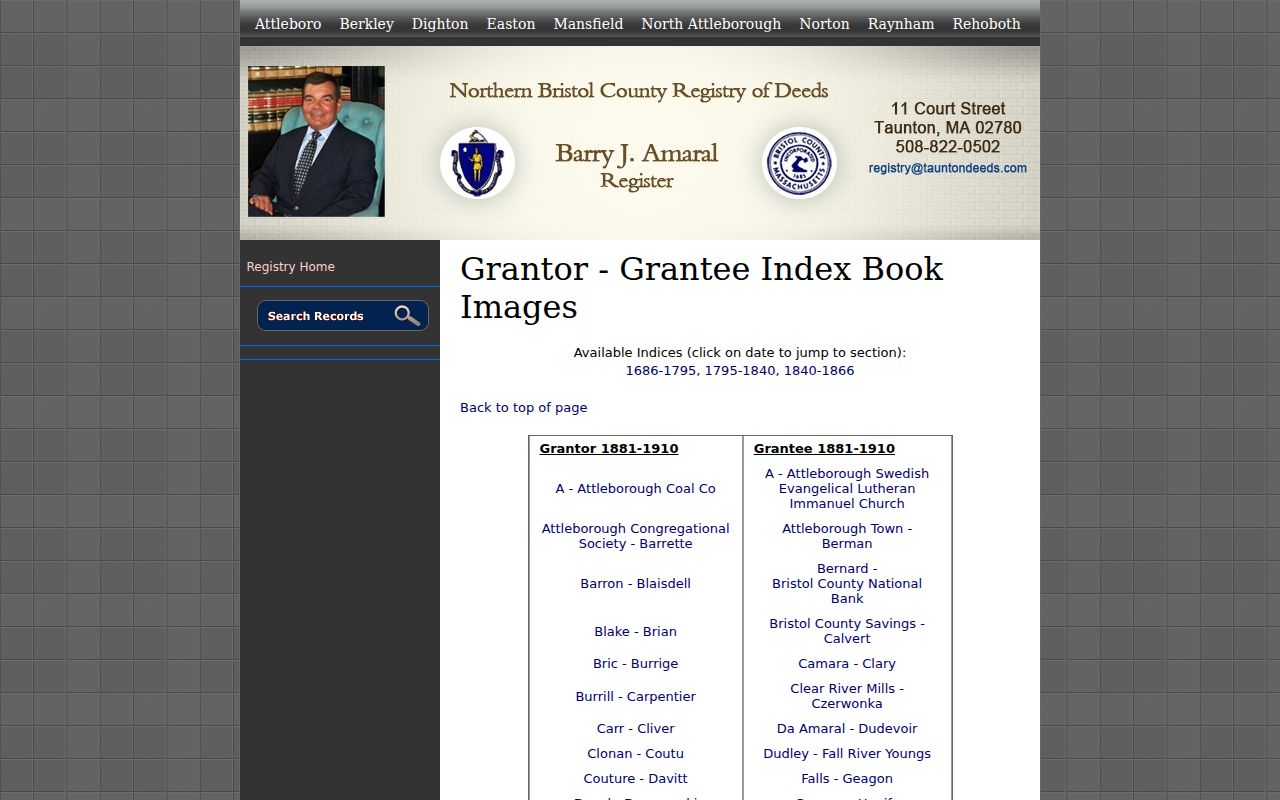
These scanned books extend the trail. They can push a North Attleborough deed chain past the modern portal workflow, but an index is still an index, so follow each reference to the deed image, book, or Registry counter before treating the connection as settled. Confirm before you conclude.
North Attleborough Past Residents Street Names
Address continuity is the biggest trap in a North Attleborough previous residents search. Streets here changed names. The John F. Sturdy House at 110 Towne Street sits on the 1858 town map under the name Elm Street. That single clue helps one historic address. It proves nothing about a townwide renumbering, and the town publishes no official street-renaming schedule. Treat each street's history on its own.
Search the current name alongside any documented former name. Then compare the 1858, 1878, and 1891 map context, the deed descriptions, and the parcel trail for the same piece of land. The Library of Congress Sanborn collection adds useful context for structures, building use, and numbering over time. Keep the limits clear. Sanborn and Bailey maps establish neither title nor occupancy.
North Attleborough's historic districts add place context of their own. Commonwealth Avenue records manufacturing at The Falls from 1809 and later jewelry activity. Cottage-Freeman development clustered between 1870 and 1890. Such dates explain why an address surfaces in one era's records and not another. They do not create a biography for an unnamed person.
North Attleborough Past Residents Households
Legal title and past residents are two different questions in North Attleborough. Let the deed chain fix the time period. Then move to dated directories and Residents' Listed Books. Add released census schedules, newspapers, and vital or probate sources as they fit. Richards Memorial Library holds local microfilm years. It also holds printed Attleboro-North Attleborough-Plainville directories from 1912 onward with gaps. Its Persons Listed volumes run annually back to 1941. For the full collection details, see the North Attleborough city directory collections.
A practical household flow works like this. Start with a dated directory listing. Add the annual Residents' Listed Book for any year from 1941 forward. Follow with the matching released census year. Then a newspaper or obituary can cover a dated event. A directory may pin down an address. A deed names a spouse, trustee, or business entity. Keep occupant findings and owner-of-record findings separate.
- Select the directory edition nearest the transfer date and copy the name spelling, address, page, and each confirmed field.
- Compare the nearest earlier and later editions rather than assuming every year exists.
- For 1941 and later, ask Richards or local Elections for the dated Persons Listed volume and its access conditions.
- Pair the address with the released census year, recognizing that census access and address presentation differ by period.
- Use the nearly complete Chronicle, Sun, and Sun Chronicle microfilm at Richards to check a dated notice, obituary, or local event.
A missing name in a North Attleborough directory or annual book proves nothing by itself. The record may be incomplete. It may use a name variant, omit the household, or be protected from disclosure. Absence does not establish a move. It does not prove a death or a departure from town. Note the negative search along with every edition and repository checked.
North Attleborough Past Residents Archives
A household trail often ends at a birth, marriage, or death. The custodian depends on the date. Massachusetts split its recordkeeping over time. The Massachusetts State Archives keeps the statewide 1841-1935 civil-registration series. It takes email requests for up to five unique records at once. Digital copies covering much of 1841-1930 sit on FamilySearch. For anything 1936 forward, RVRS is the usual route. The North Attleborough Town Clerk serves as the local starting point for town access. Recent certificates carry identity and eligibility rules. A name index is not open access to every record.
The Massachusetts Digital Archives historic vital-record collection offers an official route into the older register series.
Historic registers can support a date, a family relationship, or a place connection. They cannot replace address-specific evidence from a directory, deed chain, or parcel record. For pre-1841 work, rely on the local clerk, church and cemetery sources, probate, deeds, newspapers, and historical collections.
North Attleborough Past Residents Library Help
Richards Memorial Library is a documented fallback for North Attleborough questions. It handles buildings, previous owners, and historical occupations. Send a precise address, any former street name, an approximate period, and the record type you need. Staff can point a researcher to town histories, architectural pamphlets, directories, maps, newspaper microfilm, or another custodian. The library advertises no guaranteed house-history package and no fixed research fee.
Its named local books include North Attleboro, An Affectionate History, North Attleboro "Then and Now," Images of America, and historical works on Attleborough and Massachusetts industries. These are context sources. A record tying a past resident to an address needs a dated citation. That citation can be a directory, deed, map, newspaper, vital, or court record.
North Attleborough's Historical Commission and the National Register listings can explain a district or building's architectural setting. Use them for the place and period they document. Do not use them to reconstruct an unverified household list.
North Attleborough Past Residents Safely
Keep North Attleborough past-resident research narrow. Establish a house history, a family connection, an estate question, or a historic neighborhood record without collecting more personal detail than the source requires. Massachusetts has confidential-voter protections and an Address Confidentiality Program. A missing ordinary address can reflect protection, a record gap, or a different custodian. Never read it as proof that a person has no tie to the town.
An administrative record may not be posted online. A focused request still works. It draws on the Massachusetts Public Records Law, M.G.L. c. 66 §10. Requests can be written, emailed, mailed, or made in person. Name the record series, date range, preferred format, and any copy type needed. Registry deed copies, court records, and vital certificates keep their own procedures and restrictions.